Frederick, Maryland sits at the intersection of several major growth corridors the I-270 technology corridor stretching toward Montgomery County, the US-15 corridor running north toward Pennsylvania, and the expanding commercial districts along US-40 and Rte 26. As the city continues to grow and redevelop, commercial demolition has become a routine component of land recycling, adaptive reuse projects, and infill development throughout Frederick County. Understanding how commercial demolition Frederick works in this specific regulatory and environmental context helps property owners, developers, and facility managers navigate projects more effectively.
What Defines Commercial Demolition
Commercial demolition encompasses the planned removal of structures used for business, industrial, institutional, or mixed-use purposes. This includes office buildings, retail centers, warehouses, manufacturing facilities, gas stations, restaurants, hotels, medical offices, and any other non-residential structure. The scale ranges from a single-story strip mall bay to a multi-story office complex or an entire industrial campus.
The distinction between commercial and residential demolition matters for regulatory purposes. Commercial structures are typically subject to more extensive pre-demolition surveys, more specific notification requirements under federal and state environmental law, and more complex utility disconnection and permitting processes than standard residential work. The occupancy history of a commercial building determines which environmental regulations apply a former dry cleaner or auto repair shop carries contamination risks that a former retail building may not.
Maryland’s Regulatory Framework for Commercial Demolition
Maryland’s commercial demolition regulatory environment is shaped by overlapping federal, state, and local requirements. At the federal level, the National Emission Standards for Hazardous Air Pollutants (NESHAP) under the Clean Air Act govern the handling and disposal of asbestos-containing materials. Any commercial structure built before 1980 must be inspected for regulated asbestos-containing material (RACM) by a licensed asbestos inspector before demolition can begin. This is not optional it is a federal requirement enforced by the EPA and Maryland Department of the Environment (MDE).
MDE’s Air and Radiation Administration oversees asbestos demolition notifications. When regulated asbestos is found, the notification submitted at least 10 working days before demolition must include the quantity and type of RACM, the work practices to be used, and the disposal location. Violations of NESHAP asbestos requirements carry significant penalties.
Frederick County and the City of Frederick each issue demolition permits. City of Frederick demolition permits require submittal of a site plan, proof of utility disconnections, and for larger projects, a sediment and erosion control plan. Frederick County’s Public Works and Planning division handles permit review for properties outside the city limits. Projects within the City’s historic district may require review by the Frederick Historic Preservation Commission before demolition of contributing structures.
Maryland’s Chesapeake Bay Critical Area law applies to waterfront and near-water properties throughout the state. Demolition near streams, wetlands, or tributaries feeding the Chesapeake Bay watershed which includes all of Frederick County’s waterways must comply with Critical Area buffer requirements and may require coordination with the Maryland Critical Area Commission or MDE’s Wetlands and Waterways Program.
Pre-Demolition Assessment and Planning
A commercial demolition project in Frederick begins long before any equipment arrives on site. Pre-demolition assessment involves several parallel workstreams: environmental surveying, structural analysis, utility coordination, and regulatory review.
Environmental surveys cover asbestos, lead-based paint, PCBs (polychlorinated biphenyls, found in older electrical equipment and some building materials), mercury-containing equipment, and in the case of former industrial or service station properties, underground storage tanks (USTs) and soil contamination. Maryland’s UST program, administered by MDE, requires tank registration, proper closure procedures, and in cases of documented release, site investigation and remediation before or concurrent with demolition.
Structural analysis informs the demolition sequencing and method selection. Buildings with unusual construction post-tensioned concrete, steel moment frames, long-span structural steel require more detailed pre-demolition engineering than standard wood-frame or masonry structures. The structural analysis also identifies elements that can be salvaged and those that require special handling during deconstruction.
Utility disconnection must be coordinated with Potomac Edison (electric service), Washington Gas (natural gas), the City of Frederick’s Department of Public Works (water and sewer), and Comcast or Frontier (telecommunications). Each utility has its own disconnection process and timeline; some require formal disconnection applications well in advance of the demolition date.
Demolition Methods Used in Commercial Projects
Commercial structures are demolished using methods selected based on the structure’s size, construction type, proximity to adjacent occupied buildings, and the intended use of the site after demolition.
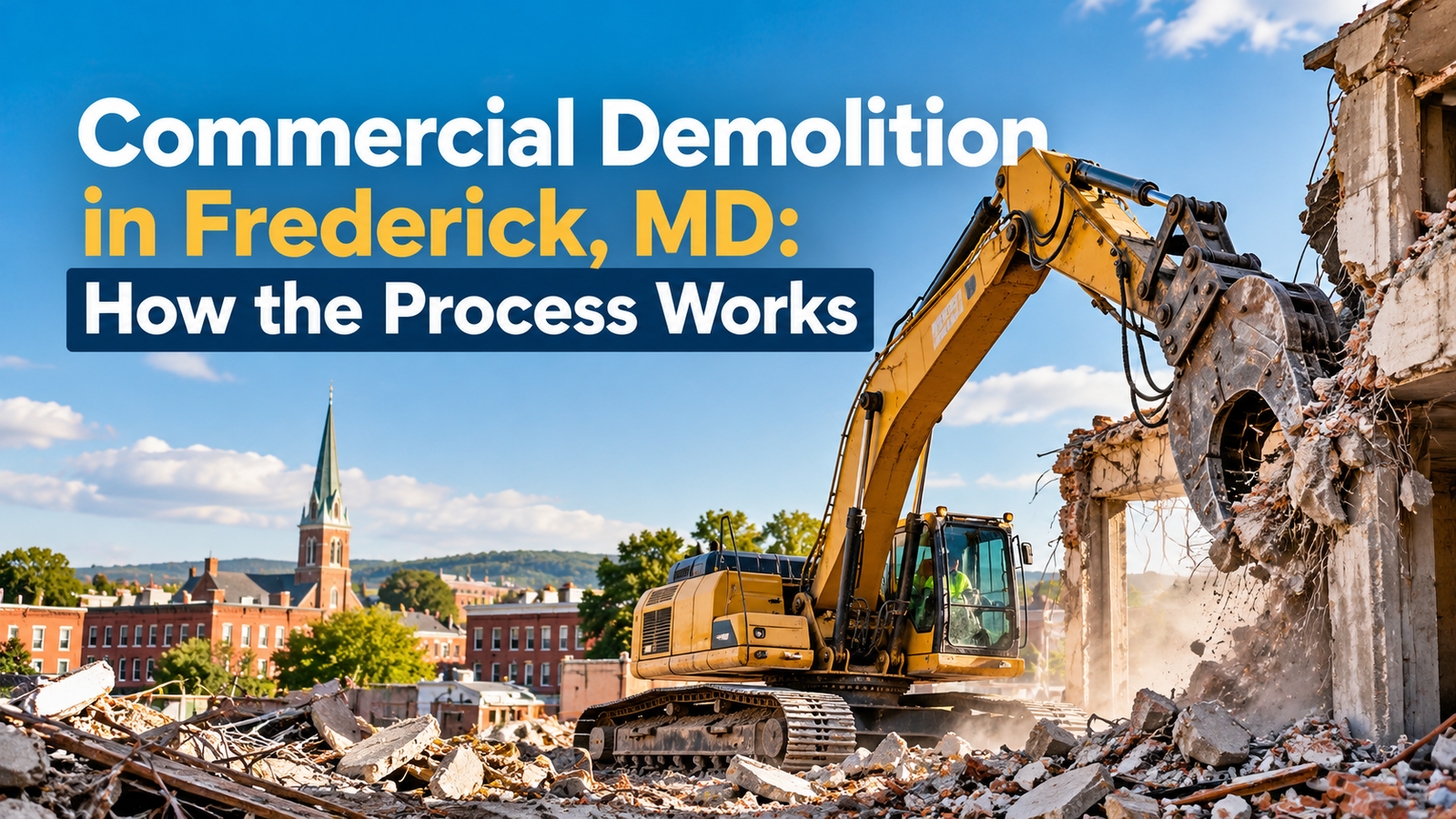
Mechanical demolition using excavators equipped with demolition attachments is the most common approach for mid-size commercial structures. High-reach excavators can safely demolish buildings up to six or seven stories without the need for implosion. Attachments including hydraulic shears (for steel), pulverizers (for concrete), and bucket crushers allow the operator to process material as it is demolished, separating steel from concrete and masonry for recycling.
Selective deconstruction the methodical disassembly of a structure to recover reusable materials is increasingly incorporated into commercial demolition projects in Frederick, particularly where LEED certification or sustainability goals drive the development program. Salvageable items including structural steel, dimensional lumber, brick, copper piping, HVAC equipment, and architectural elements are recovered before mechanical demolition proceeds on the remaining structure.
Implosion is rarely used in urban Frederick because of the proximity of adjacent structures, but it remains an option for isolated large structures where controlled collapse is the most efficient method and safe standoff distances are achievable.
Debris Management and Recycling
Commercial demolition generates substantial volumes of material concrete, masonry, steel, wood, roofing material, glass, and drywall. Maryland’s waste management regulations and the economics of material recovery have driven recycling rates for commercial demolition debris well above 80 percent on most projects.
Concrete and masonry are typically crushed on-site or at a processing facility and recycled as aggregate base material for road construction, parking lots, or fill. Steel is separated and sold to scrap metal processors. Wood from pre-1990 structures may contain lead paint and requires treatment as a regulated material; clean dimensional lumber can be chipped for biomass fuel or mulch.
Frederick County’s solid waste facilities at the Reichs Ford Road Resource Recovery Facility accept certain construction and demolition debris, and MDE regulations require that regulated hazardous materials asbestos waste, PCB-containing materials, mercury-containing devices be disposed of at permitted facilities with proper manifesting.
Common Commercial Demolition Scenarios in Frederick
Several patterns of commercial demolition recur frequently in Frederick’s development landscape. Infill redevelopment along the East Patrick Street and East Church Street corridors has involved demolition of single-story commercial buildings to make way for mixed-use development consistent with the City’s Downtown Frederick Master Plan. The I-270 technology corridor has seen periodic demolition of older industrial and flex-warehouse buildings as land values and zoning changes drive higher-intensity redevelopment.
Gas station demolition often triggered by UST closure requirements or redevelopment pressure is a specialized category that involves MDE-regulated tank removal and, frequently, soil remediation alongside the structural demolition. The Frederick area has seen multiple former gas station sites redeveloped as retail or residential uses following complete environmental closure.
Historic district demolition is perhaps the most carefully regulated category in Frederick. The city’s large and well-preserved historic district imposes review requirements and in some cases demolition restrictions on contributing structures. The Frederick Historic Preservation Commission reviews applications for demolition of structures within the historic district and may impose conditions or denial.
Site Conditions After Demolition
After a commercial structure is removed, the site requires preparation before any new construction or landscaping begins. Foundation removal either partial or complete depends on the future use: a new building may be able to use existing footings, while a parking lot or green space requires complete removal of all subsurface concrete. Underground utilities water, sewer, and gas lines serving the demolished building must be properly abandoned at the point of connection to the public system or removed, per Frederick City DPW requirements.
Grading and erosion control measures must be in place promptly after demolition to prevent sediment runoff to Frederick’s stormwater system. Frederick County’s Soil Conservation District reviews erosion and sediment control plans for projects above one acre, and inspects construction sites for compliance throughout the disturbance period.
Frequently Asked Questions: Commercial Demolition in Frederick
Does every commercial building require an asbestos survey before demolition?
Federal NESHAP regulations require a thorough asbestos inspection by a licensed inspector for all commercial structures before demolition, regardless of when the building was constructed. While the probability of finding regulated asbestos-containing material is higher in older buildings, the survey requirement applies universally. The inspector’s findings determine whether MDE notification and special work practices are required.
How long does commercial demolition permitting take in Frederick?
Permit timelines vary based on project complexity and jurisdictional workload. Simple commercial demolition permits within the City of Frederick may be processed in two to four weeks. Projects requiring historic preservation review, environmental coordination, or complex utility disconnections can take two to three months from initial application to permit issuance. Planning for permitting lead time early in project scheduling prevents delays.
What happens to underground utilities after a commercial building is demolished?
Utilities serving a demolished building must be properly terminated. Water and sewer connections to the city system are typically capped or plugged at the main, with MDE and City of Frederick DPW approval of the abandonment method. Gas lines are cut and capped by Washington Gas at the street meter. Failure to properly abandon utilities can cause safety hazards and may create liability for the property owner.
Can salvaged materials from commercial demolition be donated or reused?
Yes and in Frederick, organizations like Habitat for Humanity’s ReStore accept usable building materials from demolition projects. Architectural salvage dealers may purchase or accept doors, windows, hardware, and decorative elements from historic structures. Coordinating material recovery before mechanical demolition begins maximizes what can be salvaged, since mechanical equipment typically makes items non-salvageable once the structure is engaged.